
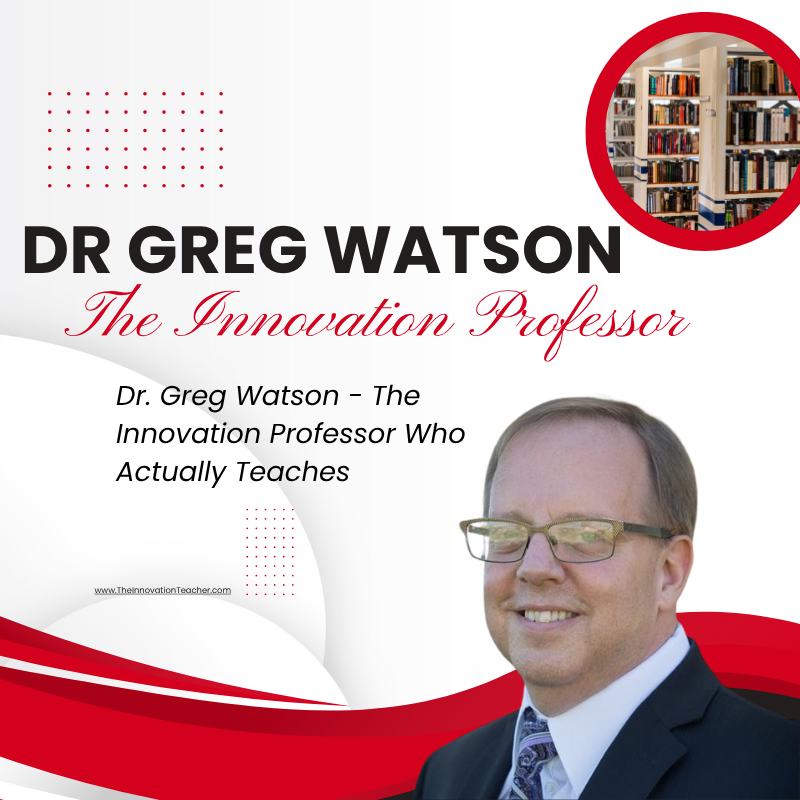
About Dr. Greg Watson
Discover the mind behind "The Innovative Professor" concept. Dr. Greg Watson is a leading authority in regional entrepreneurship strategy, impact measurement, and applied innovation policy. This section provides insights into his contributions and how to connect with his work.
Biography Persona Summary: Dr. Greg Watson, The Innovative Professor
Dr. Greg Watson embodies the modern "Innovative Professor," a role that extends far beyond traditional academic instruction to become a catalyst for economic development, a mentor for emerging entrepreneurs, and a bridge between higher education and public policy. His work provides a tangible blueprint for how a professor's expertise can be leveraged to create measurable, real-world impact. Dr. Watson's career demonstrates that true innovation in education is not confined to the classroom; it is defined by a learner-centric mindset, a commitment to experiential pedagogy, and the strategic application of research to solve complex community challenges.
The Mindset: Curiosity-Driven and Problem-Focused
An innovative professor is characterized by an insatiable curiosity and a drive to connect knowledge to practical outcomes. Dr. Watson exemplifies this through his diverse research portfolio, which spans entrepreneurial ecosystems, technology commercialization, and regional economic development.
- Lifelong Learner & Creative Thinker: His leadership of the national-scale "Everyday Entrepreneurs" study, with over 10,000 respondents, showcases a deep curiosity about the foundational drivers of entrepreneurship. He doesn't just teach existing theories; he actively generates new knowledge and "thinks outside the box" by connecting academic inquiry with on-the-ground economic realities.
- Reflective and Iterative: Dr. Watson's work is cyclical. He conducts applied research, such as the Pinal Innovation/Futures Study, translates the findings into actionable policy for government partners like Pinal County, and then integrates those same insights back into his curriculum at the University of Arizona and Pima Community College. This iterative loop of research, application, and teaching ensures his instruction is always relevant, current, and road-tested.
The Pedagogy: Experiential, Collaborative, and Learner-Centered
Dr. Watson's teaching philosophy is a direct reflection of innovative pedagogical principles, prioritizing hands-on experience and real-world application over passive knowledge transmission.
- Project-Based and Experiential Learning: As a leader in the New Venture Development program at the McGuire Center for Entrepreneurship, he has directly mentored student venture teams, guiding them through the practical challenges of building a business. This is the essence of project-based learning, where students develop critical skills like teamwork, problem-solving, and adaptability by working on authentic challenges.
- Collaborative and Community-Focused: His work transcends institutional silos. By collaborating with Tech Launch Arizona, the Pinal County government, and binational initiatives, he models the importance of building a broad-based community of practice. His recommendation to serve on the board of a proposed Arizona-Sonora entrepreneurship initiative highlights his role as a collaborative leader dedicated to fostering a cross-border innovation ecosystem.
The Impact: From Classroom Theory to Community Transformation
The ultimate measure of an innovative professor is their impact. Dr. Watson's career is defined by quantifiable outcomes that demonstrate the power of translating academic work into economic and social value.
- Fostering Critical Thinking & Real-World Problem-Solving: His research is not a theoretical exercise. The Pinal County government adopted his findings on the Arizona Technology and Innovation Corridor to inform their official economic development strategy. This provides his students with a powerful, real-time case study on how rigorous analysis can lead to tangible policy decisions.
- Measuring and Driving Success: Dr. Watson's evaluation of 71 university-launched startups is a masterclass in impact measurement. The findings—approximately $585 million in statewide economic impact, the creation of over 5,200 jobs, and $25 million+ in tax revenues—provide undeniable proof of the value of university-led innovation. This data-driven approach validates the educational model and demonstrates a clear return on investment for the community.
In conclusion, Dr. Greg Watson's professional persona is that of the quintessential Innovative Professor. He is a scholar who uses research not for its own sake, but as a tool for change. He is an educator who prepares students for the future by immersing them in the present. And he is a community leader who understands that the most profound lessons are taught by applying knowledge to create a more prosperous and dynamic world for everyone.
The Innovation Professor: Upcoming Book

Dr. Greg Watson's upcoming book, "The Innovation Professor," delves deeper into the concepts presented here, offering practical insights and strategies for educators to foster innovation in their own classrooms and beyond.
Visit The Innovation Teacher WebsiteConnect with Dr. Greg Watson
The Mindset & Core Characteristics
True innovation begins not with technology, but with a fundamental shift in mindset. An innovative professor is defined by a distinct set of personal traits, pedagogical beliefs, and professional behaviors that prioritize student learning and continuous growth. Explore the characteristics that form the foundation of innovative teaching.
Innovative Pedagogies
Innovative professors move beyond traditional lectures, embracing active learning methods that empower students to construct knowledge. This section showcases key teaching strategies that transform the classroom into a dynamic, interactive, and collaborative environment. Click on a method to learn more about its benefits and implementation.
Select a Method
Click on a pedagogical method to the left to see its detailed description, key benefits, and implementation tips here.
The Technology Toolkit
While not the sole driver, technology is an indispensable tool for enhancing the modern educational experience. Innovative professors strategically integrate digital tools to achieve pedagogical goals, personalize learning, and boost engagement. This section highlights key technologies that empower both educators and students.
The Blueprint: Curriculum & Assessment
Innovation extends to the very design of courses and how learning is measured. This involves creating flexible, relevant, and interdisciplinary curricula, and moving beyond traditional exams to assessments that foster critical thinking and real-world application. Explore the blueprint for designing transformative learning experiences.
Innovative Curriculum Design
Innovative Assessment Strategies
Measuring the Impact
Innovative teaching isn't just a philosophy; it delivers measurable results. From improved academic performance to increased student motivation and retention, the data shows a clear positive impact. This section visualizes the success of these methods and outlines the institutional challenges innovators must navigate.
Academic Performance Boost
Average grade increase in innovative vs. traditional settings.
Overcoming Institutional Barriers
Hover over a challenge to see the strategy to overcome it.
Frequently Asked Questions
Find quick answers to common questions about innovative teaching, its impact, and practical implementation.
What does it mean to be an innovative professor in today’s classroom? ▼
An innovative professor goes beyond simply using new technologies. They possess a learner-centered mindset, continuously seek new ideas, are adaptable, creative, and enthusiastic. They design transformative learning experiences that prioritize active student participation and real-world application, fostering critical thinking and lifelong learning.
How can teachers use technology to make learning more innovative? ▼
Teachers can use technology strategically to enhance pedagogical goals, not just for its own sake. This includes leveraging Learning Management Systems (LMS), interactive polling tools, AI-powered academic support, collaborative whiteboards, video conferencing with engagement features, gamification apps, and multimedia content creation tools to personalize learning, improve accessibility, and boost engagement.
What are the most effective innovative teaching strategies in higher education? ▼
Effective strategies include Project-Based Learning (PBL), Flipped Classrooms, Inquiry-Based Learning (IBL), Collaborative Learning, Gamification, Blended Learning, and Experiential Learning. These methods actively involve students in constructing knowledge, fostering deeper understanding and critical skills.
How does project-based learning improve student outcomes? ▼
Project-based learning (PBL) improves outcomes by engaging students in hands-on projects to solve real-world problems. This fosters essential workplace skills like teamwork, communication, creativity, innovation, problem-solving, and adaptability, leading to deep, reflective learning and better preparation for the job market.
Why is active learning important for college students? ▼
Active learning is crucial because it moves students beyond passive reception of information to active participation in constructing knowledge. This leads to deeper understanding, improved retention, enhanced critical thinking skills, and better preparation for real-world challenges where problem-solving and collaboration are key.
What are examples of innovation in teaching beyond using technology? ▼
Innovation extends to mindset and pedagogy. Examples include adopting a learner-centered approach, continuous reflection and iteration on teaching practices, fostering collaboration among students, designing interdisciplinary curricula, and implementing assessment strategies that require application and synthesis rather than just recall (e.g., problem-based assessments, metacognition tasks).
How can educators design learner-centered or personalized curricula? ▼
Educators can design learner-centered curricula by starting with desired long-term learning outcomes (backward design), creating personalized learning pathways tailored to individual student needs, integrating interdisciplinary and real-world relevance, and strategically incorporating technology to monitor progress and adapt instruction.
What is the difference between traditional and innovative teaching methods? ▼
Traditional methods often focus on passive content delivery (e.g., lectures) and rote memorization, with assessments primarily testing recall. Innovative methods prioritize active student participation, hands-on experiences, critical thinking, problem-solving, and application of knowledge, often leveraging technology and diverse assessment strategies to foster deeper understanding and skill development.
How does innovative teaching impact student motivation and retention? ▼
Innovative teaching significantly boosts student motivation and retention by increasing intrinsic motivation through personalized learning and gamification, enhancing engagement via interactive experiences, and fostering a positive perception of learning. This leads to improved academic performance and a stronger sense of connection, contributing to persistence.
How can faculty measure the success of their innovative teaching efforts? ▼
Success can be measured through improved academic performance (e.g., higher grades), increased student motivation and engagement (e.g., survey data, participation rates), deeper understanding (e.g., quality of project work, critical thinking assessments), and better retention rates. Continuous assessment and data-driven analysis are key to evaluating impact.